


Removing the wheel
Parking the vehicle
Immobilise the vehicle where it does not block traffi c: the ground must be level, stable and not slippery.
Apply the parking brake, switch off the ignition and engage fi rst gear * to lock the wheels.
If necessary, place a chock under the wheel diagonally opposite the wheel to be changed.
It is imperative that you ensure that the occupants get out of the vehicle and wait where they are safe.
Never go underneath a vehicle raised using a jack; use an axle stand.
List of operations
- Remove the chromed bolt cover from each of the bolts using the tool 3 .
- Fit the security bolt socket 4 on the wheelbrace 1 to slacken the security bolt.
- Slacken the other bolts using the wheelbrace 1 only.

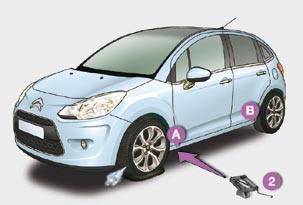
- Place the jack 2 in contact with one of the two front A or rear B locations provided on the underbody, whichever is closest to the wheel to be changed.
- Extend the jack 2 until its base plate is in contact with the ground. Ensure that the centreline of the jack base plate is directly below the location A or B used.

- Raise the vehicle until there is suffi cient space between the wheel and the ground to admit the spare (not punctured) wheel easily.
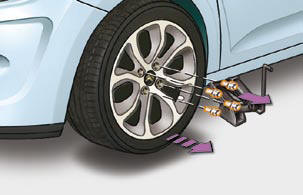
- Remove the bolts and store them in a clean place.
- Remove the wheel.
* position P for an automatic gearbox.
See also:
Maintenance indicator
Maintenance indicator
It informs you when the next routine service is due in accordance with the vehicle
servicing schedule in the Maintenance Guide. This information is dependent on two
paramete ...
Programmable heating
With the engine off, programmable heating preheats the coolant circuit in order
to optimise the engine operating temperature prior to starting.
The programmable heating system can be started imme ...
Programming
Various automatic lighting control
modes are also available according to
the following options:
- guide-me-home lighting,
- automatic lighting. ...